
⏱ 16 min read
📑 On this page (10)
- Introduction
- What Are the Pelvic Floor Muscles in Men?
- Why Every Man Should Care About Kegel Exercises for Men Benefits
- Pelvic Floor Exercises for Erectile Dysfunction: What the Research Actually Says
- How to Do Male Kegel Exercises: The 6-Step Routine
- The Malaysia Context: Why Men Here Need This More Than Most
- Safety and When to See a Specialist
- Supporting Your Practice: Lifestyle Factors That Matter
- Frequently Asked Questions
- The Bottom Line
- The muscles you want to train are the same ones that stop urine mid-stream and prevent gas from escaping.
- Research shows pelvic floor training restored normal erectile function in 40% of men in one clinical trial — for the dedicated PE-focused 8-12 week protocol see our premature ejaculation natural solutions guide.
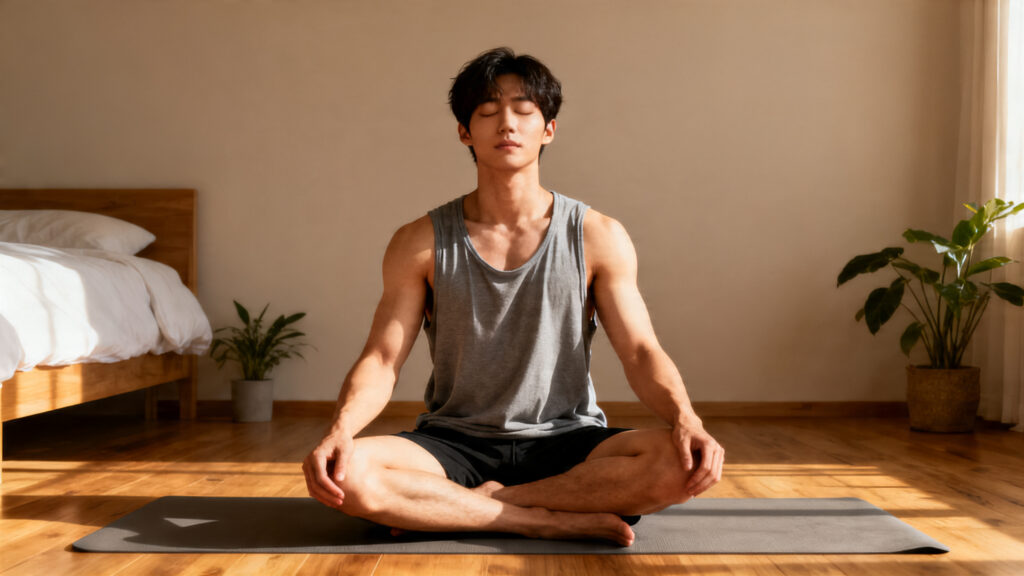
- You can do them sitting at your desk, in your car in KL traffic, or lying in bed — no one will ever see you working out.
Quick Answer
Pelvic floor exercises for men strengthen the same hammock of muscles women train — supporting the bladder, prostate, and erectile function. The basic Kegel for men: squeeze the muscle you’d use to stop urine flow, hold 5 seconds, fully relax 5 seconds, 10 reps three times daily. Consistent practice for 8-12 weeks may improve erectile firmness, help with premature ejaculation, and support prostate health for some men post-40. Locate the muscle once by stopping mid-stream — then train it away from the toilet.
Enjoyed this guide?
Get our best evidence-based intimate wellness guides in your inbox — Malaysia-specific, zero judgment, no spam. Subscribe free →
📚 This guide is part of our Life Stages & Body library. Explore all Life Stages & Body guides →
A quick note: This is general educational information, not medical advice. Pelvic floor training helps many men, but results vary and it isn’t a substitute for care — if you have incontinence, erectile difficulty, pain, or you’re recovering from prostate surgery, see a qualified doctor or pelvic-health physiotherapist, who can rule out other causes and guide your technique and timing.
Introduction
Most men never think about their pelvic floor until something goes wrong. A leak after a sneeze. An erection that fades too fast. Recovery after prostate surgery. By then, the muscle has already weakened — and most guys assume that’s just what getting older looks like.
It isn’t. The research is surprisingly clear on this one: pelvic floor exercises for men can restore erection quality, improve bladder control, and strengthen the muscles that keep the prostate healthy. In one randomised controlled trial, 40% of men with erectile dysfunction who trained their pelvic floor for six months regained normal function — without medication.
This guide is built from published clinical research and physiotherapy guidance. It’s simple, it’s evidence-based, and it works — as long as you actually do it.
And a quick note for our Malaysian readers: pelvic floor therapy is still underutilised here. Most KL urology clinics will happily prescribe pills first and never mention the muscle work that might have fixed the issue for free. You’ll see why that’s a problem by the end of this guide.
What Are the Pelvic Floor Muscles in Men?
The male pelvic floor is a hammock of muscles stretching from the tailbone (coccyx) to the pubic bone, wrapping around the base of the penis, the urethra, and the rectum. Two of them matter most for what we’re discussing:
- Bulbocavernosus — wraps around the base of the penis. It’s the muscle that pumps blood into the shaft during an erection and pushes semen out during ejaculation.
- Ischiocavernosus — sits alongside the crura (the internal root of the penis) and helps maintain rigidity once an erection is achieved.
When these muscles are strong, erections are firmer, ejaculation is more controlled, and the bladder stays where it should. When they’re weak — from years of sitting, poor posture, chronic straining, or post-prostate surgery recovery — everything downstream starts to slip.
This isn’t niche anatomy. It’s the same muscle group that women train with Kegels, which we covered in our women’s Kegel guide. The male version is less talked about, but the mechanics are identical.

Why Every Man Should Care About Kegel Exercises for Men Benefits
Let’s be direct. Here’s what consistent male pelvic floor training has been shown to improve:
1. Erection quality. The bulbocavernosus muscle is literally what makes an erection stay up. When it’s strong, blood stays in the penis longer. When it’s weak, erections fade. A 2005 BJU International study found that after six months of pelvic floor training, 74% of men with ED either regained normal function or saw significant improvement. For a broader framing of how men can build intimate wellness into daily life, our guide on self-pleasure as self-care in Malaysia covers the cultural and practical side.
2. Ejaculation control. Premature ejaculation is often — not always, but often — a control issue, not a sensitivity issue. Training the pelvic floor teaches you to consciously relax and contract the muscles that trigger ejaculation. Many men report being able to last noticeably longer within 6–8 weeks.
3. Prostate recovery and health. For men recovering from prostatectomy (prostate surgery), pelvic floor training is widely recommended after prostate surgery and may help many men regain urinary continence sooner, though recovery varies and should be guided by your care team. For men without prostate issues, regular training supports healthy drainage and may reduce the risk of chronic prostatitis. We cover product-side prostate care in our best prostate massager guide for Malaysia.
4. Urinary control. Dribbling after peeing (post-void dribble), occasional leaks during exercise or a hard laugh — all classic signs of a weak pelvic floor. This is one of the fastest things to fix. Most men see improvement within 3–4 weeks.
5. Core stability and back pain. The pelvic floor is part of your “inner core” — the deep stabiliser system along with your transverse abdominis and diaphragm. Men with chronic lower back pain often have weak pelvic floors. Strengthening one tends to help the other.
Pelvic Floor Exercises for Erectile Dysfunction: What the Research Actually Says
If you’re reading this specifically because of ED, we want to give you the honest picture — not a sales pitch.
What the evidence supports: Pelvic floor muscle training is now recommended as a first-line intervention for mild-to-moderate erectile dysfunction in several clinical guidelines. The reasoning is simple: it’s free, has zero side effects, and works for a meaningful percentage of men.
What it won’t do: If your ED is caused by severe vascular disease, nerve damage from surgery, or untreated diabetes, exercises alone won’t fix the underlying problem. You’ll still need to address the cause. But pelvic floor training is almost always worth adding to whatever else your doctor prescribes — it genuinely complements medication rather than competing with it.
Timeline: Don’t expect miracles in week one. Most studies show meaningful changes at the 8–12 week mark, with peak results around month six. Consistency beats intensity.
We’re keeping this section brief because we’re not a clinical service. For an actual diagnosis and treatment plan, talk to a urologist. In Malaysia, look for one affiliated with Subang Jaya Medical Centre, Gleneagles KL, or Pantai Hospital — all three have specialists familiar with pelvic health work.
How to Do Male Kegel Exercises: The 6-Step Routine
This is the core of the guide. Follow it in order. Don’t skip steps one and two just because they seem simple.
Step 1: Find the Right Muscles
The single biggest mistake men make is squeezing the wrong muscles. Before you train, you need to feel what you’re training.
Two reliable ways to locate the pelvic floor:
- The urine test (once, for identification only): While urinating, try to stop the stream mid-flow. The muscles you just used are your pelvic floor. Do this once — just to feel them. Don’t practice while peeing as a routine; it can mess with bladder function over time.
- The gas test: Pretend you’re trying to hold in gas in a crowded Grab ride. That squeeze — around the anus, lifting slightly upward — is your pelvic floor.
When you’ve found them, you should feel a gentle lift at the base of the penis and a drawing-up sensation at the anus. Your abs, thighs, and buttocks should stay relaxed. If they tense, you’re cheating.
Step 2: Master the Basic Contraction
Lie on your back with knees bent. Breathe normally.
- Contract the pelvic floor — lift and squeeze, like a slow elevator going up.
- Hold for 3 seconds at first. Don’t go longer until holding feels easy.
- Release completely for 6 seconds. The release matters as much as the contraction — a muscle that can’t relax is still dysfunctional.
- Repeat 10 times. That’s one set.
Do 3 sets a day for the first week. Morning, lunch, evening. Attach it to something you already do — brushing teeth, boiling the kettle, scrolling Instagram in bed.
Step 3: Progressive Loading — Build the Strength
Once the 3-second hold feels effortless (usually week 2–3), start scaling:
- Increase the hold to 5 seconds, then 8, then 10. Take a week at each level.
- Add position variety: lying down → sitting → standing → walking.
- Do sets while sitting at your desk, in the car, or in a meeting. No one will know.
Target: 3 sets of 10 reps at 10-second holds, three times a day, in any position. That’s the standard the Mayo Clinic and most pelvic health physiotherapists recommend.
Step 4: Endurance Training — Quick Flicks
Endurance is separate from strength. Add this once you can do Step 3 comfortably.
- Quick flicks: contract hard for 1 second, release for 1 second. Do 10 in a row.
- Do 2 sets of quick flicks daily, in addition to your regular slow holds.
- Quick flicks train the fast-twitch fibres — the ones you need for ejaculation control and sudden pressure moments (coughing, sneezing, lifting).
Step 5: Integrate Into Daily Life
Pelvic floor training only works if it becomes part of your routine. Stop treating it like a workout you do at a specific time — make it continuous:
- Contract before lifting anything heavy.
- Contract during the upward phase of squats and deadlifts (this actively protects you from hernia).
- Contract briefly whenever you feel sexual arousal — the mind-muscle connection carries over to performance.
- Relax deliberately during stressful moments — many men chronically grip their pelvic floor without realising, which creates its own set of problems.
At this stage you’re training several times an hour, invisibly, and it takes zero extra time.
Step 6: Avoid Common Mistakes
The six most common errors we see:
- Squeezing too hard. Pelvic floor training is about precise control, not brute force. A 60% effort contraction beats a 100% all-out squeeze.
- Holding your breath. Breathe normally throughout. If you’re holding your breath, you’re engaging the wrong muscles.
- Tensing the belly, thighs, or buttocks. Those should stay relaxed. Put a hand on each to check.
- Forgetting to release. The relaxation phase is as important as the contraction. Men who only squeeze often end up with pelvic floor tightness, which causes its own problems (pain, difficulty emptying the bladder, even ED).
- Doing them while urinating as practice. Do the urine stop-test once to identify the muscles. Then stop.
- Quitting at week 3. Real change happens between weeks 8 and 12. Almost everyone who quits does so in the first month because “nothing is happening yet.” Trust the process.
The Malaysia Context: Why Men Here Need This More Than Most
Three realities make Malaysian men higher-risk for pelvic floor weakness:
1. We sit a lot. KL and PJ office culture means 9+ hours of chair time, often in traffic both directions. Chronic sitting deactivates the pelvic floor and glutes simultaneously. By the time most guys hit 35, they have measurably weaker pelvic tone than men 30 years ago at the same age.
2. Pelvic floor physiotherapy is under-prescribed. There are excellent pelvic health physios in the Klang Valley — Pantai, Sunway, Subang Jaya, and a handful of private practices in Bangsar all have trained clinicians. But most GPs and even many urologists default to medication first. If you’ve been handed a prescription for ED or prostate issues without anyone mentioning physiotherapy, it’s worth asking directly: “Could pelvic floor therapy help here?”
3. Takaful and private insurance increasingly cover it. Many Malaysian takaful plans now cover pelvic health physiotherapy when it’s linked to a urological diagnosis. Check your policy before paying out of pocket — a 10-session programme at a private clinic typically runs RM 1,200–2,500, often partially claimable.
One more thing. The Malaysian Ministry of Health’s clinical practice guidelines on men’s health reflect modern protocols — but access at the primary care level still varies a lot. Advocate for yourself. Ask about conservative options before accepting medication as the only path.
Safety and When to See a Specialist
Pelvic floor exercises are safe for the vast majority of men. But there are situations where DIY isn’t appropriate:
- Chronic pelvic pain or tightness. If you already have a tight, painful pelvic floor, strengthening can make it worse. You need release work first — see a pelvic health physiotherapist.
- Post-surgical recovery. After prostatectomy, timing and technique matter. Start only with medical guidance.
- Severe ED or persistent urinary issues. Rule out underlying causes first. Our team references both Cleveland Clinic’s Kegel guidance and Mayo Clinic’s detailed protocol as the global gold standards — both are worth a read before you start.
If you’ve been doing the exercises correctly for 3 months and see no change, get assessed. A pelvic health physio can use biofeedback to measure actual muscle activation — sometimes men think they’re contracting and aren’t, or vice versa.
Supporting Your Practice: Lifestyle Factors That Matter
Training alone isn’t enough if the rest of your life is working against you. The things that help:
- Daily movement. Even a 20-minute walk breaks up the chronic sitting that weakens the pelvic floor.
- Hydration. Dehydration concentrates urine and irritates the bladder. Aim for 2–2.5 litres daily in our climate.
- Protein adequacy. Muscle tissue needs building blocks. If you’re restricting calories aggressively, your pelvic floor is weakening along with everything else.
- Managing chronic stress. Stress causes pelvic floor gripping. Breathwork and conscious relaxation matter as much as strengthening.
- Using body-safe products if intimate wellness devices are part of your routine. Our guide to body-safe materials explains why this matters.
Pelvic floor training is one of four pillars in our full intimate wellness guide for Malaysian men, which walks you through the whole starter routine from sleep to hygiene to body-safe products.
For gay men exploring prostate play: pelvic floor strength translates directly into better control and recovery during prostate stimulation. Our gay couple intimacy guide Malaysia covers how this integrates with partnered same-sex exploration.
Frequently Asked Questions
How long before I see results from pelvic floor exercises for men?
Most men feel subtle changes in control and firmness around week 4–6. Meaningful, noticeable improvement in erection quality and ejaculation control tends to show up between weeks 8 and 12. Peak results usually land around six months of consistent practice.
Can Kegels really help with erectile dysfunction?
Yes, for mild-to-moderate ED, the evidence is solid. A landmark randomised trial published in BJU International found 40% of men regained normal erectile function after six months of pelvic floor training alone. Another 34.5% saw significant improvement. It won’t cure ED caused by severe vascular or nerve damage, but it’s worth trying before — or alongside — medication.
Is it safe to do male kegel exercises every day?
For most men, yes. Three sets a day is the standard recommendation. Where men get into trouble is squeezing 100+ times a day with no release work — that can create pelvic floor tightness, which causes its own ED, pain, and urinary symptoms. Strength without the ability to relax is dysfunction.
Does this help with prostate health?
Yes, in two ways. For men recovering from prostate surgery, pelvic floor training is widely recommended and may help speed continence recovery for many men, though individual recovery varies. For men without prostate issues, regular pelvic floor activation supports healthy blood flow and drainage around the prostate area, which may reduce chronic prostatitis risk.
What if I can’t feel the pelvic floor muscles at all?
This is actually common, especially if you’ve been sedentary for years. Two options: use the urine stop-test once to locate them, or visit a pelvic health physiotherapist who can use biofeedback to show you on a screen exactly when you’re contracting correctly. A single assessment session (RM 200–350 in KL) can save months of wrong-muscle training.
Can I overdo it?
Yes. Symptoms of overtraining include pelvic pain, difficulty starting urination, sensation of incomplete bladder emptying, and paradoxically — worse erections. If you experience any of these, stop strengthening and focus on breath-based relaxation until symptoms clear. Then resume with lower volume.
Does pelvic floor training help with premature ejaculation?
It can, meaningfully. Studies on men with lifelong PE show training the pelvic floor — particularly the ability to relax the muscles on demand — increases intravaginal ejaculation latency time. The mechanism: voluntary relaxation of the bulbocavernosus gives you more runway before the ejaculation reflex triggers. Give it 8–12 weeks.
Will pelvic floor exercises interfere with gym lifting or running?
No — the opposite. A well-trained pelvic floor protects against hernia during heavy lifting and reduces stress urinary incontinence during running. Many experienced lifters and endurance athletes eventually discover pelvic floor work and wonder why nobody mentioned it earlier. Just make sure you’re also training relaxation, not only contraction.
The Bottom Line
Pelvic floor exercises for men are one of the highest-return wellness habits we’ve researched — low time investment, zero cost, strong evidence base, and tangible benefits for erection quality, ejaculation control, prostate recovery, and bladder function. The only catch: you have to actually do them. Consistently. For at least eight weeks before judging results.
If you’re reading this in KL, PJ, or anywhere else in Malaysia, treat this as the starting protocol. Begin with the 6-step routine above. Give it three months. If you’re still not seeing what you expected, book a session with a pelvic health physiotherapist at one of the hospitals we mentioned — they’ll tell you within 20 minutes whether you’re doing the movement correctly.
For more on intimate wellness fundamentals — what “body-safe” actually means, how to choose the right products, and what most brands get wrong — start with our Intimate Wellness Malaysia beginners’ guide or browse the full intimate wellness glossary.
Small daily investment. Real physiological change. That’s what pelvic floor exercises for men deliver — and it’s why our editorial team considers this the single most under-rated wellness habit for Malaysian men over 30.
Loving this article?
Get our free 10-page Intimate Wellness Starter Guide — same editorial standard as this article. No spam. Unsubscribe anytime.
Related reading: For the full first-timer’s walkthrough on choosing a male stroker in Malaysia — material safety, budget tiers, and where to buy discreetly — see our Male Masturbator Malaysia: A First-Timer’s Buying Guide.
Partner store
Ready to shop?
We don’t sell products here — when you’re ready, our partner store carries body-safe picks with discreet delivery across Malaysia.
Browse Secret After Dark →🎁 Join our Telegram channel for a channel-only 10% code at Secret After Dark →
Start here · The path
Not sure what to read next? New here? Follow this 4-step path for a solid foundation 👇
Keep reading




10 Replies to “Pelvic Floor Exercises for Men: The Essential Guide to Better Health and Performance (2026)”
Best Prostate Massager Malaysia: Complete Beginner's Guide (2026)
[…] healthy circulation and drainage around the prostate for everyone else. See our complete guide to pelvic floor exercises for men for the 6-step evidence-based […]
Intimate Wellness Malaysia: 7 Essential Tips for Beginners | Maison Velvetia
[…] — improving erection quality, prostate recovery, and bladder control. Our dedicated guide to pelvic floor exercises for men walks through the evidence-based 6-step protocol with Malaysia […]
Kegel Exercises Benefits: Essential Guide for Women (2026)
[…] clinical focus is different. If you’re looking for the male version, see our full guide to pelvic floor exercises for men — covering erection quality, prostate recovery, and Malaysia-specific […]
Self Pleasure Self Care Malaysia: The Essential Wellness Guide 2026
[…] Pelvic floor strength — for men too (see our pelvic floor exercises for men) […]
Intimate Wellness for Men in Malaysia: A First-Time Guide to Male Self-Care (2026) - Maison Velvetia
[…] forward to 2026 and the conversation has shifted. Malaysian men are reading about pelvic floor training, prostate wellness, lube selection, body-safe materials, and even how to choose lubricant without […]
How to Talk About Sex With Your Partner: Malaysian Couples Guide 2026
[…] There is a specific sexual concern — erectile difficulty, pain during intercourse, disappearing desire — that warrants medical or psychological assessment. (For pelvic-floor specific context, see our Kegel guide for women or pelvic floor exercises for men.) […]
Gay Couple Intimacy Malaysia: Judgment-Free 2026 Guide
[…] floor strength matters here too. We’ve covered the male pelvic floor guide in depth, and those exercises become especially relevant for men exploring prostate play because […]
Best Couples Sex Toys Malaysia: 2026 Beginner Guide
[…] with exercises, not toys. We cover this in detail in our kegel exercises guide and pelvic floor exercises for men guide. Toys layer beautifully on top of a healthy pelvic floor. If the floor needs work, addressing […]
Premature Ejaculation Natural Solutions: Evidence-Based Malaysian Men's Guide (2026) - Maison Velvetia
[…] ejaculatory control should be measurably better. We’ve covered the broader benefits in our pelvic floor exercises for men guide, which goes deeper on the anatomy and […]
Male Masturbator Malaysia: A First-Timer's Complete Buying Guide (2026) - Maison Velvetia
[…] grip and pressure pattern). For the wider picture of male intimate wellness practice, revisit our pelvic floor exercises for men […]