

⏱ 25 min read
📑 On this page (17)
- Why a lesbian intimacy guide Malaysia needs (and why most articles fail at it)
- Communication: the unsexy foundation everyone skips
- Building a small, intentional kit (not a drawer of impulse buys)
- The Malaysian context: discretion, not invisibility
- Beyond toys: rituals that actually move the needle
- What about kids, fertility, and long-term planning?
- Sex without orgasm as the goal
- When to bring in outside help
- A small note on language
- The smallest version of this guide
- The Lesbian Advantage in Orgasm — What the Data Shows
- Strap-On as Primary Tool — The Full Guide
- Lesbian-Specific Safer Sex — Dental Dam Realtalk
- Scissoring — The Physiology and Safe Practice
- FAQ
- About the editor
- Sources
TL;DR
A wellness-first lesbian intimacy guide Malaysia — written for women-loving-women (WLW) couples who are tired of advice columns that assume a script borrowed from straight sex. We cover communication, the difference between sexual frequency and emotional intimacy, body-safe product picks that don’t centre penetration, and how to do all of this discreetly under Malaysia’s Section 377 reality.
Quick verdict: The single biggest predictor of long-term WLW intimacy isn’t toys, lingerie, or weekend getaways — it’s the willingness to say what you actually like out loud, repeatedly, without shame. Start there. Then build a small kit of body-safe wellness tools you both chose together. Two or three quality items beat a drawer full of impulse buys.
This is the lesbian intimacy guide Malaysia we wished existed two years ago. When our team started mapping out the intimate wellness content gap for Malaysian readers, the lesbian-specific resource shelf was almost empty. The few articles ranking on Google MY were either US-import listicles assuming you can walk into a Brooklyn boutique on a Tuesday afternoon, or older blog posts that quietly defaulted every single suggestion back to penetrative sex. Both miss the audience we keep hearing from — Malaysian women in their late twenties to early forties, in committed WLW relationships, who want a wellness guide that takes their actual sex life seriously.
So we wrote this. It’s a long read — about a 12-minute one — and we’re not going to pretend we have all the answers. What we do have is a body of research from the Kinsey Institute, the GLAAD media reference guide, and direct conversations with WLW friends across KL, PJ, Penang and JB about what they actually wished someone had told them at the start. That’s what’s in here.
Quick Answer
Lesbian intimacy in Malaysia centers communication, body-safe shared products, and sexual health awareness — within a legal and cultural environment that calls for discretion. Practical essentials: water-based lubricant for any toy or partnered play, body-safe silicone toys cleaned between users, dental dams or cut condoms for oral safety, and regular STI screening every 6-12 months (HPV and herpes transmit between women, often underdiagnosed). Pleasure and health coexist — start with one shared toy under MYR 300, and check in with each other after every new experience.
Enjoyed this guide?
Get our best evidence-based intimate wellness guides in your inbox — Malaysia-specific, zero judgment, no spam. Subscribe free →
📚 This guide is part of our LGBTQ+ Wellness library. Explore all LGBTQ+ Wellness guides →
A quick note: This is general educational information, not medical or legal advice. If a product ever causes pain, burning, bleeding, swelling, or lasting irritation, stop using it and speak to a qualified healthcare professional.
Why a lesbian intimacy guide Malaysia needs (and why most articles fail at it)
Most mainstream sex advice is written from a heteronormative template. The default scene goes: foreplay → penetration → orgasm (his) → maybe orgasm (hers) → end. Even articles ostensibly written for queer women often quietly inherit this structure — they just swap in a strap-on and call it inclusive.
That structure doesn’t fit the actual research on WLW sexual experience. The 2017 Frederick et al. study published in Archives of Sexual Behavior found that lesbian women reported orgasm during partnered sex 86% of the time, compared to 65% for straight women — and the researchers attributed the gap largely to longer encounters, more clitoral focus, and explicit communication during sex. In other words: the WLW script is already different. It rewards talking, time, and tools that don’t centre penetration as the main event.
And yet, the cultural pressure to “perform” sex in a recognisable way persists. We’ve heard from couples who own four different strap-on harnesses they’ve used twice, because that’s what they thought a lesbian couple was supposed to do. We’ve also heard from couples who have wonderful sex lives and worry they’re “doing it wrong” because they don’t.
This guide is for both. There is no script.
Communication: the unsexy foundation everyone skips

If we could only tell you one thing in this entire guide, it would be this: the conversations that build intimacy almost never happen in bed. They happen at a cafe in Bangsar on a Sunday afternoon, in the car driving back from your in-laws, in the kitchen while you’re chopping vegetables. Pick the unsexiest possible moment. That’s when you talk about sex.
This is something we’ve covered in depth in our broader guide to talking about sex with your partner, but there are a few WLW-specific patterns worth flagging.
The “we already understand each other” trap
Because you both share a body type, there’s a strong assumption — sometimes spoken, often not — that your partner automatically knows what you want. After all, you have one of these too. You should know what feels good, right?
That assumption is the single biggest blind spot we hear about from long-term WLW couples. The truth is that anatomy varies wildly. What works for your clitoris may be unbearably intense for hers. The pressure she likes may be too light for you. Texture preferences, rhythm preferences, where you want to be touched first, where you don’t want to be touched at all — none of this is encoded by gender. It’s encoded by you, individually.
The fix isn’t a single dramatic conversation. It’s small, repeated check-ins, ideally not in the heat of the moment. “I noticed you went quiet when I did X — was that good quiet or not-good quiet?” is a kinder, more useful question than “Did you finish?”
Scheduling without killing the spark
This one is controversial in the wellness space, but our take is: schedule it. Especially if you’re both working full-time, sharing a condo, juggling family obligations, and dealing with the everyday low hum of being queer in a country where you can’t fully be out. Spontaneity is a beautiful idea that often loses to exhaustion.
Scheduling doesn’t mean putting “sex, 9pm” in your shared calendar. It means agreeing that Friday nights are protected — no errands, no in-laws, no Netflix as default. What happens during that protected time is open. Sometimes it’s sex. Sometimes it’s a long bath together and a film. Sometimes it’s just talking in bed for two hours. The protected window itself is the intimacy lever.
The “low desire” partner conversation
Mismatched libido is the most common issue we hear about in WLW couples — almost more common than in mixed-gender couples, partly because the “lesbian bed death” stereotype gets internalised and pre-emptively pathologised. But desire mismatches are normal in every long-term relationship, and they’re rarely about how attractive you find each other. They’re about stress, hormones, sleep, mental load, perimenopause for couples in their late thirties and forties, and a hundred other variables.
If this is you, please read our piece on self-pleasure as self-care. Solo intimate wellness is not a betrayal of partnered intimacy — for many couples, the partner with higher solo wellness has higher partnered desire too. The pressure to make every orgasm a couple’s project burns people out.
Loving this article?
Get our free 10-page Intimate Wellness Starter Guide — same editorial standard as this article. No spam. Unsubscribe anytime.
Building a small, intentional kit (not a drawer of impulse buys)
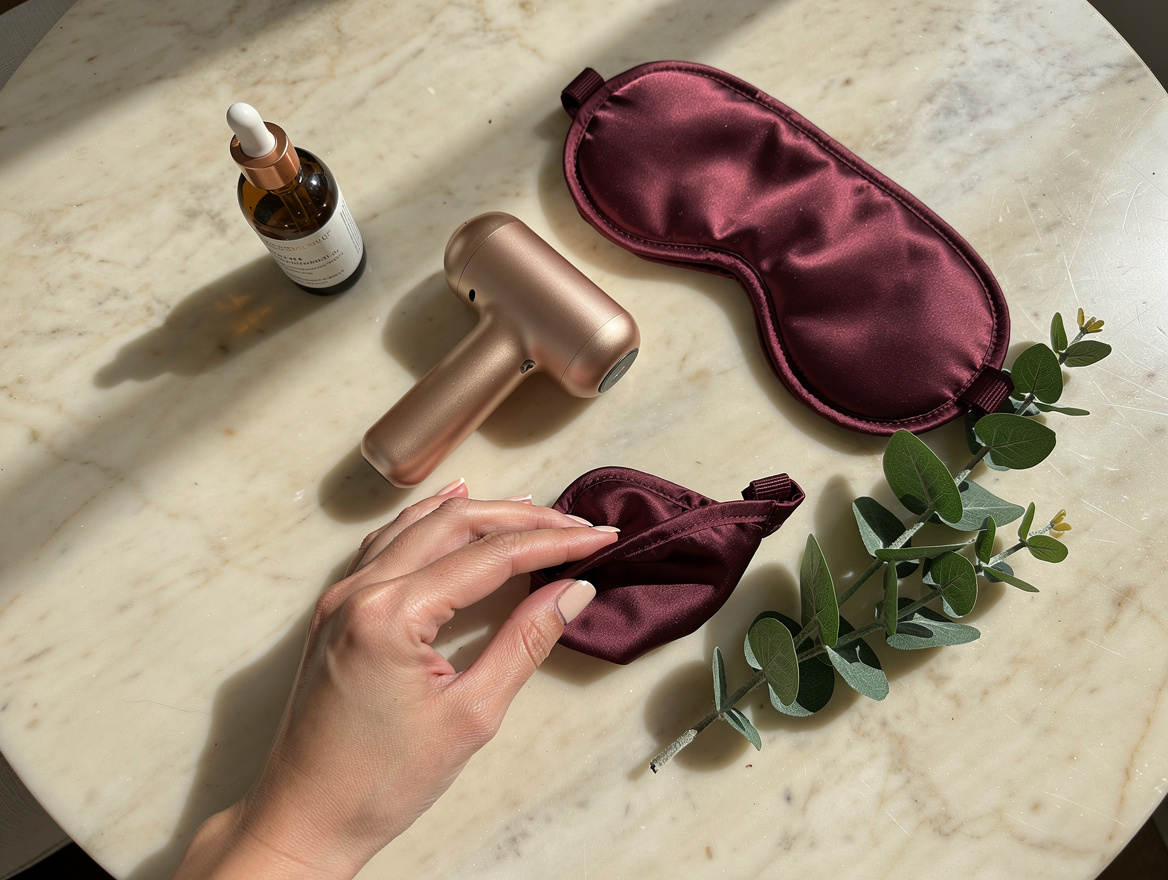
The biggest mistake new WLW couples make when shopping for intimate wellness products is buying too much, too fast. The drawer fills up with strap-ons, harnesses, three different vibrators, ben wa balls, and a bottle of lube that turns out to be silicone-based when half your toys are silicone (more on that in a moment). Six months later, two items get used regularly and the rest live in a shoebox.
Our suggestion: start with three things. Add a fourth only when you’ve actually used the first three for at least a month each.
Item 1: One excellent external vibrator
For most WLW couples, an external clitoral vibrator is the single highest-value purchase. It works for solo use, for partnered use during oral or manual stimulation, and for both partners — you don’t need to buy two. Look for medical-grade silicone (we explain why in our body-safe sex toy materials guide), USB rechargeable, IPX7 waterproof, and at least three intensity levels.
The category sweet spot in Malaysia is around MYR 250–450. You can spend more for premium brands like LELO or We-Vibe, but the meaningful jump in quality plateaus around MYR 350. Below MYR 150 you’re typically getting white-label hardware with undisclosed silicone blends — body-safety unverifiable.
Item 2: A good water-based lubricant
This one is non-negotiable. Even with high arousal, lube extends comfort and reduces friction-related irritation. Water-based is the safe default — it’s compatible with every toy material and every condom (yes, dental dams and finger cots count, see Item 4). Avoid anything with glycerin, parabens, or “warming” additives, which can disrupt the vaginal microbiome.
The Malaysian retail picks we trust: pjur Original (water-silicone hybrid, available at Watsons), Sliquid Naturals H2O (online via Lazada/Shopee from authorised resellers), or Yes Water-Based Organic (more expensive, KL specialty stores). Skip Durex Play and KY — both contain glycerin.
Item 3: Something tactile that isn’t a toy
This is the one most lists skip. A silk eye mask, a soft body brush, a high-quality body oil for slow massage, a pair of cotton wrist ties (loose, not BDSM-grade — this is about sensation, not restraint). The goal is to expand the sensory vocabulary of your intimacy beyond “vibrator on / vibrator off.” Touch, temperature, texture, deprivation of one sense to amplify another — this is where WLW intimacy often shines, because there’s no script driving you toward a single climactic event.
Item 4 (optional, after month 3): Barrier protection if you want it
STI transmission rates in WLW couples are lower than in mixed-gender couples but not zero — HPV, herpes, and bacterial vaginosis can pass between female partners. Dental dams (latex sheets) and finger cots (single-finger latex covers) are the standard barrier tools. They’re stocked at Guardian and Watsons but often only in the “family planning” section behind the pharmacist counter — you may need to ask. There’s no shame in this; pharmacists in MY are professionally bound to discretion.
If you’re new to barrier methods or unsure what your testing schedule should be, please consult a doctor. WHO’s STI fact sheet is a good starting reference, but it’s not a substitute for in-person medical advice.
The Malaysian context: discretion, not invisibility
Let’s be honest about where we live. Section 377 of the Malaysian Penal Code criminalises “carnal intercourse against the order of nature” — language that is deliberately vague and has been historically used against same-sex relationships. Public displays of WLW affection range from “tolerated” in some KL/PJ neighbourhoods to “actively unsafe” in more conservative areas. The legal and social environment shapes how Malaysian WLW couples navigate intimacy in ways that US/UK guides don’t address.
Practically, this means a few things for intimate wellness:
- Discreet shipping matters. Most reputable Malaysian intimate wellness retailers (including us) ship in plain unmarked packaging with generic sender names. If a retailer doesn’t explicitly promise this, pass. Our full breakdown is in how to buy sex toys in Malaysia discreetly.
- Storage. Many WLW couples we’ve spoken to store their intimate wellness items in plain fabric pouches inside locked drawers or under-bed boxes. Not because there’s anything to hide morally, but because shared apartments, family visits, and household help are real factors lah.
- Travel within Malaysia. If you’re driving from KL to Penang or JB for a getaway, pack toys in your checked luggage in a fabric pouch. Travel batteries are usually fine for domestic travel; international travel is more complex (we’ve covered that in traveling with intimate devices).
- Community. The WLW community in KL/PJ exists but is largely whispered. Justice for Sisters, PT Foundation, and Diversity Malaysia are real-world support resources — not for products, but for community and mental health support if you need it.
What “out” means is different here
One thing we want to gently push back on: the assumption that all WLW couples want to be visibly out as a measure of relationship health. In Malaysia, choosing to keep your relationship private — from family, employer, neighbours — is often a survival decision, not a relationship problem. A WLW relationship can be healthy and fulfilling and very intentionally not visible. The wellness work is internal to the couple, not performed for an audience.
Beyond toys: rituals that actually move the needle
If you take only one action item from this guide, make it this: build one small recurring ritual together that is not about sex. The couples we know with the strongest long-term intimacy almost always have one — and it’s almost always something deliberately small.
Examples we’ve collected:
- Sunday morning kopi at the same kopitiam for two years running.
- A 20-minute walk together every evening after dinner, no phones.
- One Friday a month where one partner plans the entire evening as a surprise — meal, activity, music — and the other has no input until it happens.
- Ten minutes of just lying in bed together in the morning before either of you reaches for a phone. Not talking required.
- A monthly check-in question: “What’s one thing I did this month that you really appreciated?” — followed by “What’s one thing you wish I’d done differently?”
None of this is sex. All of it builds the trust capital that makes the sexual conversations easier. Couples who have these rituals report that when difficult intimacy conversations come up — desire mismatch, fertility planning, body changes — the conversation lands on a foundation of “we are a team that handles things together,” not “we are two people who occasionally have problems to fix.”
What about kids, fertility, and long-term planning?
This is outside the strict scope of an intimacy guide, but it’s worth flagging for WLW couples in Malaysia who are thinking about families. IVF and donor conception for same-sex couples is legally complex in Malaysia — most clinics will not openly serve unmarried or same-sex couples, and many MY couples travel to Bangkok, Singapore, or further for treatment. This is a huge stressor that often impacts intimacy, sometimes for years, and we mention it because the wellness conversation rarely acknowledges it.
If you’re navigating this, please find a queer-affirming therapist or join an online community for queer parents in SEA. The intimacy work continues alongside the fertility work — they are not in conflict, but the latter sometimes consumes all the oxygen.
Sex without orgasm as the goal
One of the most freeing reframes we’ve encountered, especially for couples in their late thirties and forties, is dropping orgasm as the obligatory endpoint of every sexual encounter. This is sometimes called karezza in older literature, but you don’t need a label — the practice is simple: have intimate physical encounters where the explicit agreement is “no climax expected from either of us tonight.”
Counterintuitively, this often leads to deeper, longer, more inventive sex over time. The performance pressure drops. You explore touch and pacing that gets short-circuited when an orgasm goal is in the air. And it’s particularly helpful for couples where one partner is in a low-desire phase — sex stops being a transaction with a fixed cost, and becomes a flexible space.
This is, incidentally, an area where WLW couples sometimes have a structural advantage: there’s no cultural assumption that male ejaculation needs to be the closing event. You’re freer to define what “the encounter is over” means.
When to bring in outside help
Wellness guides should be honest about their own limits. There are a few situations where a blog post — including this one — is not enough.
- Persistent pain during intimacy. If sex is painful for either partner more than occasionally, see a gynaecologist. Conditions like vulvodynia, vaginismus, and endometriosis are real, treatable, and under-diagnosed in MY because of cultural reluctance to discuss intimate symptoms. Sunway Medical, Pantai, and Subang Jaya Medical all have OBGYN specialists who treat these conditions; ask for a doctor experienced in pelvic pain specifically.
- Trauma history affecting intimacy. A queer-affirming therapist makes a major difference here. The Malaysian Association of Counselling can refer; some therapists in KL/PJ specifically advertise queer-affirming practice (you’ll have to look beyond the public listings sometimes).
- Mental health affecting desire. Depression and anxiety reliably suppress libido. SSRIs do too. If you’ve been on antidepressants for a while and your sex life has changed, that’s a conversation worth having with your prescribing doctor.
- Communication patterns that feel stuck. Couples therapy with a queer-affirming counsellor is not a sign of relationship failure — it’s a sign of relationship investment. We know couples who do annual “tune-up” sessions even when nothing’s wrong.
For a broader framework on relational intimacy that applies to all couples (and doubles as foundation reading for WLW partners), see our companion piece on sex toys for couples in Malaysia and the gay couple intimacy guide — both have communication frameworks that translate across same-sex dynamics.
A small note on language
We use “WLW” (women-loving-women), “lesbian,” and “queer women” somewhat interchangeably in this guide because that reflects how Malaysian WLW community members we’ve consulted actually describe themselves — there’s no single agreed term, and pushing one is its own kind of erasure. If you identify as bisexual, pansexual, or your sexuality doesn’t fit a clean label, this guide still applies. The intimacy principles aren’t gated by identity label.
For trans women in WLW relationships, much of this guide applies, with additional considerations around hormone-affected sensation, dysphoria-aware touch, and surgical history (if relevant). We’re working on a dedicated trans-affirming intimacy guide — if you want to be notified when it publishes, the subscribe form on this page will reach you.
The smallest version of this guide
If you read nothing else: pick one ritual to start this week (the 10-minute morning silence one is the easiest), have one honest conversation in the next month about what you actually want more or less of in your sex life, and buy one good external vibrator together if you don’t already have one. That’s it. Three actions. The rest of this guide will still be here when you’re ready.
The Lesbian Advantage in Orgasm — What the Data Shows
This part isn’t speculation. It’s one of the most cited findings in sex research. Frederick et al. published a 2018 study in Archives of Sexual Behavior analysing orgasm rates across 52,000 US adults: 86% of lesbian women said they usually or always orgasm during partnered sex, compared to 65% of heterosexual women and 89% of heterosexual men. The 21-point gap between lesbian and straight women has held up across follow-up studies and is now widely known as the orgasm gap inversion.
“Lesbian women orgasmed more often than heterosexual women, with no significant differences in psychological wellbeing or relationship satisfaction by orientation.”
— Frederick, Bohrnstedt, et al., Archives of Sexual Behavior, 2018. Full paper.
Lesbian couples consistently outperform on orgasm — here’s what their patterns reveal about intimate communication. It is not biology. Two vagina-owners are not anatomically superior. The differences researchers consistently document are about practice — how sex is paced, talked about, and structured. WLW couples spend more time on non-penetrative pleasure, communicate more during sex, and treat clitoral stimulation as primary rather than a warm-up. None of this requires being lesbian to apply.
The four patterns worth borrowing
- Clitoral stimulation as the main event, not the appetiser. Most WLW sex doesn’t treat clitoral attention as something to “work through” before penetration. It’s often the destination itself.
- Verbal feedback in real time. “A bit higher,” “softer,” “yes — keep doing exactly that” — lesbian readers tell us this kind of running narration is normal in WLW intimacy and absent in many hetero relationships.
- Longer pace, less linear escalation. Penetrative-focused scripts push toward a single climax point. WLW sex more often loops, pauses, and returns — multiple orgasms or none in one session, no shame either way.
- Aftercare as part of sex, not optional. Cuddles, water, conversation — the after isn’t a polite formality, it’s part of what made the during work.
Strap-On as Primary Tool — The Full Guide
Mainstream sex writing treats strap-ons as kinky or accessory. In a lot of WLW relationships, a strap-on is the primary tool for penetrative play — not a novelty, not a roleplay prop, just a piece of well-considered gear. Worth understanding properly.
Harness types — pick by fit, not by aesthetic
- Jockstrap-style — comfortable for long wear, leaves the wearer’s vulva accessible (this matters more than first-timers expect), good for daily-use couples
- Brief-style / boy-shorts harness — secure fit, distributes pressure across hips rather than thighs, best for vigorous play
- Two-strap (G-string back) — minimal coverage, good if either partner wants the wearer’s body more visible during play
- Thigh harness — niche but worth knowing — straps the dildo to the thigh rather than the pelvis, opens up positions that pelvic harnesses can’t reach
Dildo size and material — body-safe non-negotiables
- Material: medical-grade silicone only. The TPE / TPR / “jelly” cheap options out-gas chemicals and are porous, which means they harbour bacteria you cannot fully clean. Silicone is body-safe, fully sterilisable, lasts a decade. Our body-safe materials guide covers the ISO 10993 standard.
- Size — start smaller than you think. First-time strap-on play: 4–5 inch insertable length, modest girth. The harness adds a learning curve. You can always size up later.
- O-ring compatibility. Most harnesses use interchangeable O-rings (typically 1.25, 1.5, 1.75, 2 inch). The dildo’s flared base needs to fit through the chosen O-ring. Always test-fit before buying.
- Vibrating dildo or attached bullet? A small clitoral vibe pressed against the wearer from the inside of the harness changes who orgasms — and how reliably. Many WLW couples use this to give the wearer (not just the receiver) reliable clitoral stimulation.
Position dynamics — rider vs missionary
Rider-on-top gives the receiver full control over depth and rhythm — usually the easier first-time position. Wearer-on-top (missionary or variants) gives the wearer control of pace and lets the wearer initiate eye contact and kissing during penetration. Couples typically experiment and find their default in the first month. There’s no correct answer.
For lube pairing: the silicone dildo + water-based lube rule applies — silicone lube will degrade a silicone dildo. Pick water-based, glycerin-free, pH-matched. See our 4-question decision tree on lube choice and our 10-pick Malaysia shortlist for the picks — and if you’re still choosing the toy itself, how to choose a body-safe dildo in Malaysia.
Lesbian-Specific Safer Sex — Dental Dam Realtalk
Most mainstream safer-sex content assumes condoms and stops there. WLW couples deserve actual coverage of the tools made for them. Dental dams — thin latex (or polyurethane for latex allergies) sheets used as a barrier during oral sex — are the underrated piece of WLW safer-sex equipment, and the awkward truth is that most lesbian couples we hear from don’t use them, even when they intellectually know they should.
What dental dams actually prevent
- HSV-1 and HSV-2 transmission during oral-vaginal or oral-anal contact
- HPV transmission — important because cervical HPV is the underlying cause of cervical cancer, and WLW are more likely to skip Pap smears, not less
- Bacterial transmission during oral-anal play (rimming)
- STIs you both forgot you were carrying — most STIs are asymptomatic; both partners testing negative on a recent panel does not mean you’ll stay that way after new partners
Getting them in Malaysia
Dental dams are not stocked at most Watsons or Guardian branches in Malaysia. Practical options:
- Shopee Mall or Lazada LazMall — search “dental dam” or “oral sex barrier”; multiple international brands ship to Malaysia
- PT Foundation in Klang Valley sometimes distributes them free as part of safer-sex outreach — worth checking
- DIY from a condom — cut a non-lubricated latex condom along its length, unroll, you have a rectangular barrier. Not ideal but better than nothing
- Plastic wrap — non-microwave-safe cling film (heated film is too thin) used to be the standard recommendation; effectiveness data is weaker than purpose-made dams but it’s used in a pinch
Scissoring — The Physiology and Safe Practice
Scissoring is one of those positions mainstream porn renders as cinematic and most lesbian couples we know describe as “awkward and not quite worth it.” Both descriptions have truth to them. The mechanics are more delicate than they look, and friction injury is a real possibility. Here’s what to actually know.
Why it’s harder than it looks
- Pelvic geometry varies a lot between people — the position requires both partners’ pubic bones to align in a way that produces clitoral contact
- Without lube, friction injury to vulvar tissue is a real risk in extended sessions
- Most couples find variants (one partner’s leg over the other’s hip rather than full leg-overlap) more accessible
Practical adjustments that help
- Plenty of water-based lube on both partners — friction without lube damages tissue and shortens any session well below useful
- Pillow under the lower partner’s hips — lifts pelvis and improves angle of contact
- Side-leg variant — one leg over the partner’s hip and one leg under, rather than full overlap; most couples find this more sustainable
- Use it as one part of a session, not the main act — most WLW couples we hear from say scissoring is more enjoyable as a bridging position than as a destination
For our gay male readers navigating a different set of dynamics (top/bottom/verse, PrEP, conservative MY context), our gay couple intimacy guide Malaysia is the parallel companion to this one. The gay dating Malaysia guide also serves as the broader LGBTQ resources hub for both communities.
FAQ
What does WLW mean?
WLW stands for “women-loving-women” — an umbrella term that includes lesbian, bisexual, pansexual, and queer women in same-sex relationships. We use it because it’s broader and less culturally loaded than “lesbian” alone, and it doesn’t assume identity label.
Is lesbian intimacy in Malaysia legal?
Same-sex relationships exist in a legal grey zone under Section 377 of the Malaysian Penal Code, which criminalises “carnal intercourse against the order of nature.” Enforcement against private consensual adult intimacy is rare but not zero. We are not legal advisors — for clarity on your specific situation, consult a Malaysian human rights lawyer such as those at SUARAM or Justice for Sisters.
Where can I buy body-safe intimate wellness products discreetly in Malaysia?
Reputable Malaysian online retailers ship in plain unmarked packaging with generic sender names. Watsons and Guardian carry water-based lubricants and condoms openly; for vibrators and more specialised products, online is the discreet-by-default option. Avoid international shipping where possible — customs holds add risk and delay.
Do WLW couples need lubricant?
Yes — even with high natural arousal, water-based lubricant extends comfort, reduces friction-related irritation, and is essential for using barrier protection like dental dams. Choose a glycerin-free, paraben-free water-based formula. Skip “warming” or scented variants which can disrupt the vaginal microbiome.
How do same-sex female couples handle desire mismatch?
Desire mismatch is normal in all long-term relationships and is not a sign of failure. The most effective strategies we’ve seen: schedule protected couple time without forcing sex during it, support each partner’s solo wellness practice, address underlying stressors (sleep, mental load, hormones), and consider couples therapy with a queer-affirming counsellor if patterns feel stuck.
What’s the best first sex toy for a lesbian couple?
For most WLW couples, a single high-quality external clitoral vibrator made of medical-grade silicone, USB rechargeable, IPX7 waterproof, with at least three intensity levels. It works for both solo and partnered use, and benefits both partners — no need to buy two. Budget MYR 250–450 for the sweet spot. Skip strap-ons until you’ve explicitly talked through whether you both want one.
Are dental dams really necessary?
STI transmission between female partners is lower than in mixed-gender couples but not zero — HPV, herpes, BV, and trichomoniasis can pass between WLW partners. Dental dams provide a barrier during oral sex. Use depends on your relationship structure (monogamous vs not), STI testing history, and personal preference. If unsure, regular STI testing for both partners is the baseline.
How do I find queer-affirming healthcare in Malaysia?
Justice for Sisters, PT Foundation, and Diversity Malaysia maintain informal referral networks. Some KL/PJ private hospitals (Pantai, Sunway Medical, Sunway Velocity) have OBGYNs experienced in non-judgmental care. Always feel free to leave a clinic that makes you uncomfortable — your wellness is not negotiable.
About the editor
Mae Chen
Mae Chen is the editorial pen name of the Maison Velvetia editorial team, covering intimate wellness for Malaysian and Southeast Asian readers since 2026. Our team blends clinical research, real-world WLW community input, and a refusal to write advice that pretends Malaysia’s social context doesn’t exist.
Editorial standards: every health claim cites a specific source. Every product recommendation is sourced from publicly verifiable specs. Every guide is reviewed quarterly. Read more about Mae Chen or browse our intimate wellness glossary.
Sources
Independent, authoritative sources cited in this guide. Our full sourcing and corrections standards are set out in our Editorial Policy & Standards.
Editor’s note (May 2026): For the gay-male equivalent of this guide focused on dating-phase wellness, our companion piece on gay dating Malaysia 2026 covers the same ground for single MSM readers — apps, first dates, status conversation, and PrEP through Klinik Kesihatan.
Partner store
Ready to shop?
We don’t sell products here — when you’re ready, our partner store carries body-safe picks with discreet delivery across Malaysia.
Browse Secret After Dark →🎁 Join our Telegram channel for a channel-only 10% code at Secret After Dark →
Start here · The path
Not sure what to read next? New here? Follow this 4-step path for a solid foundation 👇
Keep reading


One Reply to “Lesbian Intimacy Guide Malaysia: A 2026 Wellness Companion”
Best Gay Couple Intimacy Guide Malaysia: 2026 Edition
[…] our lesbian readers navigating a parallel set of pressures with different community norms, our lesbian intimacy guide Malaysia is the companion piece. For single gay men exploring dating apps, PrEP conversations, and […]