
⏱ 19 min read
📑 On this page (10)
- What Makes a Material Body-Safe?
- The Best Body-Safe Sex Toys: Approved Materials Checklist
- Dildo Materials Deep Dive: Which Body-Safe Option Is Right for You?
- 2026 Malaysia Market Reality: What You’re Actually Buying
- Materials to Avoid: The Non-Toxic Sex Toys Problem
- How to Read a Material Listing Before You Buy
- Why This Matters: The Real Health Risks
- What a Trustworthy Listing Actually Contains
- Frequently Asked Questions
- Final Thoughts
When it comes to intimate wellness products, understanding body safe sex toy materials is one of the most important steps you can take before making any purchase — yet it’s a topic most retailers never bother to explain.
TL;DR
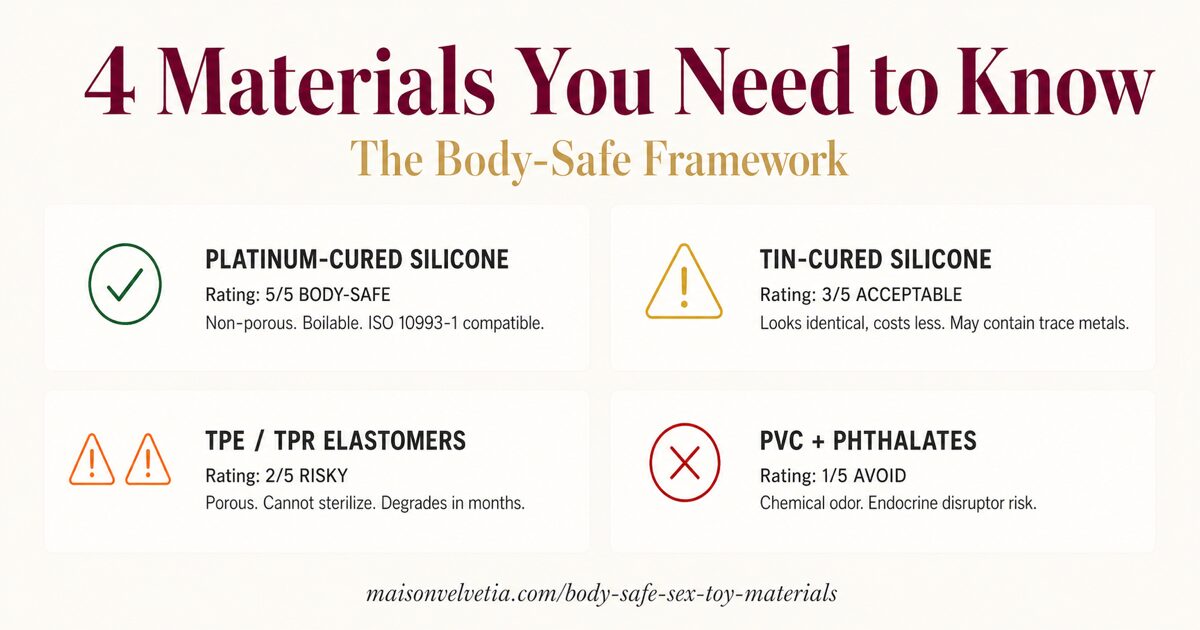
Only four materials are genuinely body-safe: medical-grade silicone, ABS plastic, surgical-grade stainless steel, and borosilicate glass. Everything else — jelly rubber, PVC, “silicone blend,” unregulated TPE — is porous, potentially toxic, and impossible to fully sterilise.
Key takeaways
- Body-safe = non-porous + non-toxic + hypoallergenic + stable. All four, no exceptions.
- Avoid jelly rubber, PVC, TPE, and “Cyberskin” — they harbour bacteria permanently.
- The smell test is your first filter: a strong plasticky odour on unboxing is a red flag.
Quick Reference: Safe vs. Avoid
| Material | Porous? | Body-safe? | Lube pairing | Verdict |
|---|---|---|---|---|
| Platinum (medical-grade) silicone | No | Yes | Water-based only | ✅ Safe |
| Borosilicate glass | No | Yes | Any | ✅ Safe |
| Stainless steel | No | Yes | Any | ✅ Safe |
| ABS plastic | No | Yes | Any | ✅ Safe |
| Jelly / rubber | Yes | No — often contains phthalates | — | ❌ Avoid |
| PVC / vinyl | Yes | No | — | ❌ Avoid |
| TPE / TPR (“skin-like”) | Yes | Not for internal use | — | ⚠️ Avoid |
| “Silicone blend” (unverified) | Usually | Unverifiable — treat as porous | — | ❌ Avoid |
The reality? Some products on the market contain harmful chemicals that can cause irritation, allergic reactions, and long-term health concerns. Others are perfectly safe, durable, and designed with your body in mind. This guide cuts through the confusion: what “body-safe” actually means, which body safe sex toy materials pass the test, which ones to avoid, and how to shop for genuinely non toxic sex toys with confidence.
If you travel often inside Malaysia with body-safe devices, our domestic travel discreet wellness Malaysia guide covers tropical-heat storage limits and the 10-minute returning-home cleaning routine that keeps medical-grade silicone in good shape for years.
Quick Answer
The only truly body-safe sex toy materials are 100% medical-grade silicone (ISO 10993 certified), borosilicate glass, surgical stainless steel, and high-quality ABS plastic. Avoid anything labeled ‘silicone blend’, ‘jelly’, ‘TPE’, ‘PVC’, or vague ‘novelty material’ — these are porous, often contain phthalates, and can’t be properly sanitized. There is no fully reliable at-home test that can confirm a finished product’s exact formulation, so check the manufacturer’s material disclosure and any finished-product safety documentation before you buy.
Enjoyed this guide?
Get our best evidence-based intimate wellness guides in your inbox — Malaysia-specific, zero judgment, no spam. Subscribe free →
📚 This guide is part of our Products & How-To library. Explore all Products & How-To guides →
A quick note: This is general educational information about product materials, not medical advice. “Body-safe” is a screening framework, not a regulated guarantee — always check a product’s own material documentation. If a product ever causes pain, burning, bleeding, swelling, or lasting irritation, stop using it and speak to a qualified healthcare professional.
Just want to know which one to buy?
This guide is about the materials. If you’re ready to pick an actual dildo — beginner sizes, what to look for, and where to buy discreetly in Malaysia — jump to the best body-safe dildos and how to choose one.
What Makes a Material Body-Safe?
“Body-safe” is not a regulated industry term — there’s no official certification body that stamps a product as approved. However, the wellness industry has developed a clear set of criteria that define body safe sex toy materials:
- Non-porous — The material has no microscopic holes where bacteria, mould, or bodily fluids can accumulate. Porous materials cannot be fully sterilised, no matter how thoroughly you clean them.
- Non-toxic — Free from chemicals known to be harmful, particularly phthalates, BPA, and heavy metals.
- Hypoallergenic — Unlikely to cause allergic reactions or irritation, even for those with sensitive skin.
- Stable — The material doesn’t degrade, off-gas harmful compounds, or break down under normal use conditions.
A material that meets all four criteria qualifies as body-safe. A material that fails even one — particularly the non-toxic requirement — is a health concern. According to Healthline’s guide to intimate product safety, many budget products fail this standard without any labelling to warn consumers.
Free: The Body-Safe Materials Cheat Sheet
The whole nonporous-vs-porous list on one page — which materials are safe, which to skip, how to clean each. Screenshot-ready, straight to your inbox.
🔒 Prefer not to share your email? Join our anonymous Telegram channel → Zero personal info, leave anytime.
The Best Body-Safe Sex Toys: Approved Materials Checklist
1. Medical-Grade Silicone
The gold standard of body safe sex toy materials. Medical-grade silicone is non-porous, fully sterilisable via boiling, autoclave, or hospital-grade isopropyl wipe (do not use bleach — it degrades silicone over time and leaves residue that can irritate mucous membranes), free from phthalates and harmful plasticisers, hypoallergenic, and temperature-stable. Its soft, velvety texture also makes it one of the most pleasant materials against skin.
How to identify genuine silicone: Real silicone doesn’t retain odour, doesn’t stain, and feels velvety rather than sticky. Press the surface firmly — genuine silicone springs back cleanly without leaving a dent.
Important caveat: Not all silicone is equal. “Silicone blend” or “silicone feel” products may contain only a fraction of actual silicone mixed with cheaper, unsafe materials. Always look for “100% medical-grade silicone” or “platinum-cured silicone” — nothing less.
2. ABS Plastic
ABS (acrylonitrile butadiene styrene) is a rigid, hard plastic used in medical devices, food containers, and precision engineering. For intimate wellness products, it’s non-porous, easy to clean, free from phthalates and BPA when sourced from reputable manufacturers, and highly durable. It’s commonly used for bullet vibrators, device exteriors, and control surfaces.
3. Surgical-Grade Stainless Steel
Surgical-grade stainless steel (316L) is among the safest body safe intimate products materials available. It’s completely non-porous, sterilisable by boiling, hypoallergenic, and compatible with all lubricant types — including silicone-based and oil-based formulas. It’s also temperature-responsive, which some users find adds an interesting dimension to sensation.
4. Borosilicate Glass
The same material used in laboratory glassware and high-quality cookware. Borosilicate glass is non-porous, completely sterilisable, compatible with all lubricant types, and provides a uniquely smooth, gliding surface. Its firmness and temperature responsiveness make it a distinct sensory choice preferred by many experienced users.
5. Hard Anodised Aluminium
Less common but equally safe when properly anodised. The anodising process creates a sealed, non-porous surface layer that’s corrosion-resistant and lightweight — an appealing alternative to stainless steel for those who prefer a lighter product.
Dildo Materials Deep Dive: Which Body-Safe Option Is Right for You?
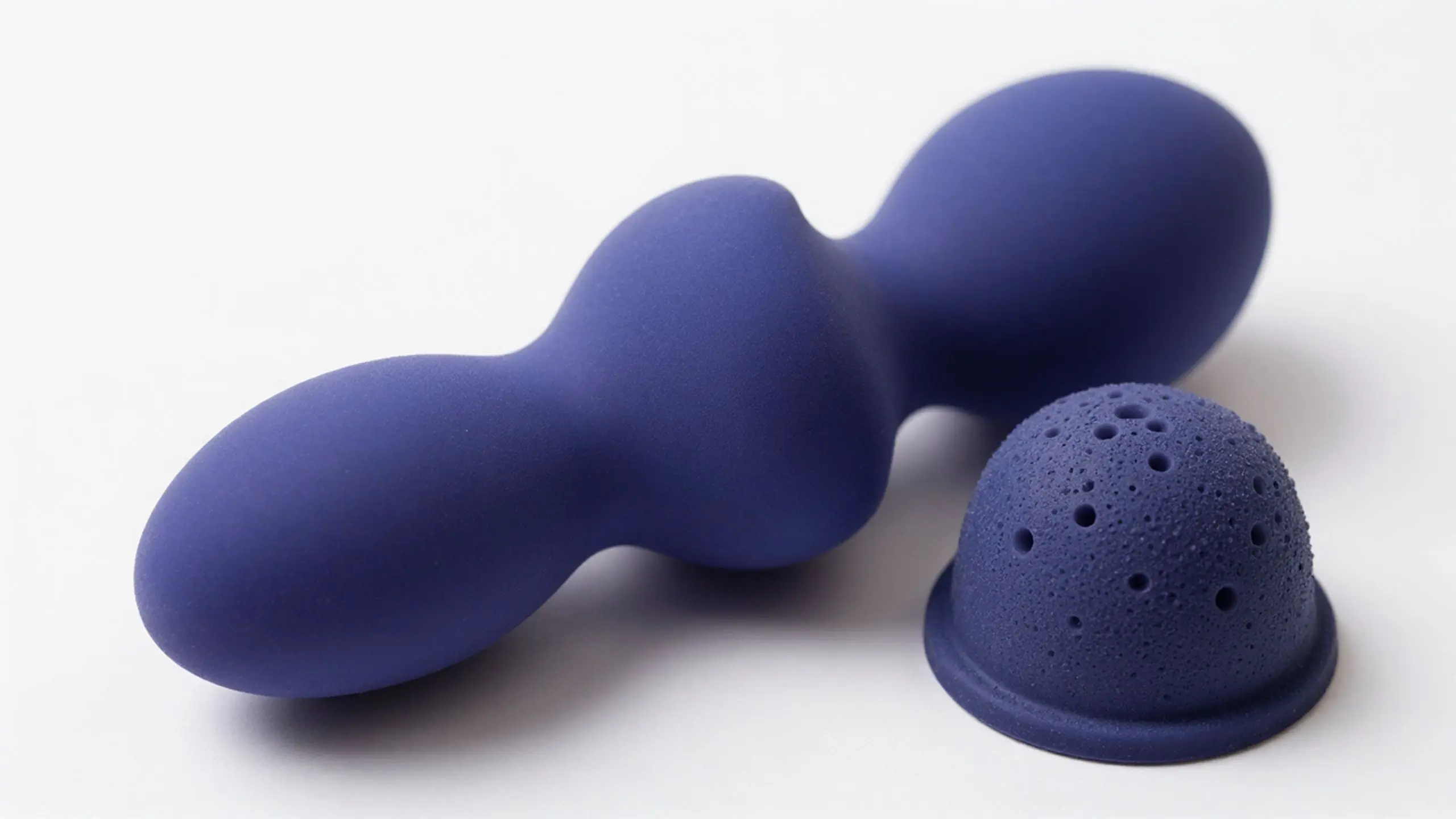
Dildos sit in a unique category of body safe intimate products — they’re often used internally for extended sessions, with deeper tissue contact than external vibrators. That makes material choice doubly important. Here’s how the three genuinely best body-safe dildo materials 2026 compare in real-world use:
Silicone Dildos — The All-Rounder
Medical-grade silicone dildos offer the most forgiving entry point: body-warming, slightly flexible, and available in every shape and size. The soft-firm balance suits beginners and experienced users alike. For a step-by-step buyer’s walkthrough, read our guide on how to choose a body-safe dildo in Malaysia. Pair with water-based lubricant only — silicone lube will degrade the surface over time. Boilable for full sterilisation between uses.
Glass Dildos — Temperature Play & Smooth Glide
Borosilicate glass is rigid, weighty, and provides a uniquely smooth gliding sensation. Compatible with every lubricant type (including silicone-based), easy to warm or cool for temperature play, and visually striking. The firmness is the trade-off — it’s not a forgiving first-time material for anyone sensitive to rigid pressure. Reputable brands use annealed borosilicate that won’t shatter under normal use.
Stainless Steel Dildos — Weight & Pressure
Surgical-grade 316L stainless steel is the heaviest option, which many experienced users specifically seek for deeper internal pressure and a cold-to-warm temperature curve. Completely non-porous, autoclavable, and compatible with all lubricants. The weight (typically 400g–1kg) is both the selling point and the learning curve.
What to Avoid in Dildos Specifically
Jelly rubber and “Cyberskin” dildos are the worst offenders on the market — porous, often phthalate-laden, and impossible to sterilise despite extended internal use. Realistic-feel materials marketed as “lifelike” are almost always PVC-silicone blends that trap bacteria permanently. If a dildo smells strongly out of the box or feels sticky, it fails the body-safe test.
2026 Malaysia Market Reality: What You’re Actually Buying
Here’s the uncomfortable truth about body safe intimate products on the Malaysian market: general wellness products and items with a medical intended purpose can fall under different rules, and material-disclosure practices vary between sellers — so in practice a lot of the quality checking falls on you. Owning intimate wellness items for private, personal use is widely treated as a personal matter in Malaysia, though this isn’t legal advice and restrictions can apply to import and sale. What you see labelled as “silicone” on Shopee or Lazada often isn’t.
👉 Shopping in Malaysia specifically? The buying-side playbook (Shopee/Lazada listing red flags, price traps, seller checks) lives in our companion guide: how to tell if a sex toy is body-safe before you buy.
A pattern shows up across locally listed “silicone” products: very cheap listings marketed as “silicone” often can’t back it up with a clear, verifiable material spec — though price on its own can’t confirm what something is actually made of. Genuine medical-grade silicone vibrators and dildos in Malaysia typically start at RM200–RM300 for entry-level models from reputable international brands, with premium ranges (LELO, We-Vibe, Njoy) sitting RM400+.
Why the price gap? Medical-grade silicone is expensive — raw material cost alone can be 10–15× higher than jelly rubber or budget TPE. When something very cheap is listed as silicone, the economics are hard to square — which is a good reason to ask the seller for a clear material spec and documentation before trusting the label.
Three rules for the Malaysian buyer (2026):
- Only buy products that explicitly state “100% medical-grade silicone” or “platinum-cured silicone.” Vague descriptors like “silicone feel” or “premium silicone blend” are marketing language, not material disclosures.
- Stick to internationally recognised brands. LELO, We-Vibe, Satisfyer, Njoy, Fun Factory, and Tantus publish material specifications and back their products with warranties. If a brand’s website doesn’t clearly state what a product is made from, walk away.
- Be cautious with very cheap marketplace listings that claim to be silicone but don’t name a verifiable material. Treat an unusually low price as a prompt to ask for documentation, not as proof on its own.
For the most rigorous buyers, look for brands that cite ISO 10993-1 biocompatibility testing on their material safety pages — the same medical device biocompatibility standard used for implants and surgical instruments. Third-party laboratories like Intertek’s medical device biocompatibility testing programme certify silicone formulations against ISO 10993’s cytotoxicity, sensitisation, and irritation panels. Brands that proactively cite this level of testing aren’t common, but when they do, it’s a strong signal of genuine body-safe compliance.
Looking for a body-safe pick? Browse our partner store →
Materials to Avoid: The Non-Toxic Sex Toys Problem
The challenge with finding genuinely non toxic sex toys is that many products don’t clearly disclose their materials — or deliberately use misleading terminology. Here are the materials that should raise immediate red flags:
Jelly Rubber (PVC with Phthalates)
The most commonly found unsafe material in budget intimate products. Jelly rubber is highly porous (meaning bacteria live permanently inside the material), frequently contains phthalates — chemical plasticisers linked to hormonal disruption — and cannot be sterilised by any cleaning method. It also tends to off-gas chemical odours that signal the presence of toxic compounds.
Red flags: Strong chemical smell when unboxed, extreme flexibility without returning to shape, very cheap price point, no material disclosure.
Unregulated TPE/TPR
Thermoplastic elastomers and thermoplastic rubbers vary enormously in quality. Budget formulations are often porous, may contain phthalates, and degrade over time — becoming sticky and releasing chemicals into direct contact with your body. Some premium brands do use certified, phthalate-free TPE formulations, but these should carry explicit certification rather than vague assurances.
PVC (Polyvinyl Chloride)
PVC requires chemical softeners to achieve the flexibility used in intimate products — and those softeners are almost always phthalates. The result is a material that’s porous, impossible to fully clean, and frequently contains endocrine-disrupting chemicals. Its characteristic chemical smell is a reliable warning sign.
“Cyberskin” and Proprietary Realistic Materials
Brand names like Cyberskin, Ultraskin, and Fanta Flesh are typically porous blends of PVC and silicone. Despite their realistic texture and premium pricing, they’re porous, cannot be sterilised, and must be replaced regularly as bacteria accumulates within the material. These are not non toxic sex toys, regardless of how they’re marketed.
How to Read a Material Listing Before You Buy
Shopping confidently for body safe intimate products requires a little due diligence. Here’s what to look for:
- Explicit material disclosure. Reputable brands state their materials precisely: “100% medical-grade silicone,” “ABS plastic,” “316L stainless steel.” Vague descriptors like “skin-safe,” “premium feel,” or “body-friendly” are not sufficient — they mean nothing without specifics.
- Recognised brand reputation. Established brands like LELO, We-Vibe, Satisfyer, and Njoy openly publish material specifications. If a brand cannot tell you exactly what their products are made from, that’s a clear red flag.
- Realistic pricing. Genuine medical-grade silicone costs significantly more than jelly rubber or cheap PVC. A “silicone vibrator” priced far below the going rate often isn’t genuine silicone — treat it as a reason to ask for material documentation, not a certainty.
- Phthalate-free certification. Some products carry phthalate-free labels or CE certifications — positive indicators, though not the complete picture.
- The nose test. Body safe sex toy materials have little to no chemical odour. A strong, plasticky smell on unboxing is a serious warning sign — and a reason to return the product immediately.
Why This Matters: The Real Health Risks
The most sensitive tissue in the body — mucous membranes — is precisely where unsafe intimate products come into direct contact. The consequences of choosing materials that aren’t truly body safe sex toy materials include:
- Bacterial infections from porous materials that harbour bacteria between uses, even after cleaning
- Allergic reactions ranging from mild irritation to severe dermatitis
- Phthalate exposure — linked in peer-reviewed research to hormonal disruption and reproductive health concerns
- Recurring infections caused by material sensitivity or persistent bacterial contamination
The good news? Choosing verified body safe intimate products from reputable brands entirely eliminates these risks. The market for non toxic sex toys has never been better — or more accessible in Malaysia.
Pairing a body-safe silicone toy with the right lubricant matters — glycerin-heavy lubes and silicone-based lubes can both compromise the toy surface. Our best lubricant in Malaysia guide flags which picks are toy-safe and glycerin-free.
What a Trustworthy Listing Actually Contains
You do not have to take any seller’s word for it. Before you buy, the listing itself should answer four things — and a listing that dodges any of them has already told you something:
- A named material, not a mood. “100% medical-grade silicone,” “ABS plastic,” “surgical steel,” or “borosilicate glass” — not “skin-safe,” “premium,” or an unqualified “silicone.”
- The material appears in the first product image or the written description, not only in a reply to someone else’s question.
- A warranty period stated in writing. A seller unwilling to stand behind a device for twelve months has told you what they think of it.
- Cleaning and charging instructions specific to that material, rather than copy-pasted boilerplate that would fit any product.
Those four checks are about the listing. Once the thing is in your hands, the questions change — porosity, smell, surface feel — and we walk through those separately in how to tell if a sex toy is body safe. Maison Velvetia does not sell products — this is an editorial site, which is why the checklist above is not pointed at anyone’s catalogue. Body-safe intimate products shouldn’t be a premium feature. They should be the baseline for every purchase, and those four checks are how you hold a seller to it.
If you’re just beginning your wellness journey, read our beginner’s guide to vibrators in Malaysia — including what materials to insist on for your first purchase. And if you’re building out your wellness kit, our complete guide to choosing lubricant in Malaysia explains how material compatibility affects your lubricant choices. For a broader introduction to intimate wellness in Malaysia, start with our intimate wellness beginner’s guide.
If you found this helpful, our condom buying guide Malaysia covers the brand, material, and sizing side of things in full.
Frequently Asked Questions
What are the most popular body-safe dildo materials in 2026?
In 2026, the most popular body-safe dildo materials are 100% medical-grade silicone (the all-rounder — flexible, body-warm, easy to sterilise), borosilicate glass (smooth, great for temperature play), and surgical stainless steel (weighty, firm, near-indestructible). All three are non-porous, non-toxic and phthalate-free. Body-safe silicone stays the most popular because it balances realism and safety; glass and steel are favoured for firmness and effortless cleaning. The materials to skip in 2026 are jelly rubber, PVC and unregulated TPR — porous types that trap bacteria and can’t be fully sanitised.
Are realistic dildos body-safe?
Realistic dildos can be body-safe — but only when they’re made from 100% platinum-cured silicone. Many ultra-realistic toys use “Cyberskin”, “UR3” or other proprietary blends that are porous and often contain phthalates, so they harbour bacteria and can’t be sterilised. If you want a realistic dildo, confirm the material is explicitly named as medical-grade or platinum silicone — not a vague “realistic material” or “silicone blend.” When the realistic dildo’s material isn’t clearly named, treat it as body-unsafe.
What are the red flags of non-body-safe materials?
Five quick red flags: a strong chemical smell straight out of the box; a sticky or greasy surface; vague labels like “novelty use only” or “silicone blend”; a price that looks too good to be true; and a seller who can’t tell you exactly what the material is. Any two together — walk away.
What are the best body-safe sex toys to buy in Malaysia?
The best body-safe sex toys are made from 100% medical-grade silicone, ABS plastic, stainless steel, borosilicate glass, or pure aluminium — all non-porous, non-toxic, and easy to sterilise. For Malaysian readers, our picks live in three sub-guides: best vibrators for beginners in Malaysia (clitoral / bullet / wand options), best prostate massager Malaysia for men, and first sex toy women’s decision framework. The common thread: avoid anything labelled vaguely as “silicone blend,” “jelly,” or “TPE/TPR” — those are the materials that fail body-safe screening even when sold as adult wellness products.
How can I tell if a product is genuinely medical-grade silicone?
Genuine medical-grade silicone feels velvety (not sticky), doesn’t retain odour, and springs back cleanly when pressed firmly. None of these feel-tests are proof on their own, so for anything you can’t confirm by touch, check the manufacturer’s stated material and documentation. “Silicone blend” products often feel tacky, retain smells, and may warp under heat.
Are all silicone products body-safe?
No. Only 100% medical-grade or platinum-cured silicone meets the body-safe standard. Products labelled “silicone blend,” “silicone feel,” or using similar vague language may contain significant proportions of unsafe materials. Always insist on unambiguous material disclosure.
Can I use silicone lubricant with silicone toys?
No — silicone-based lubricants can degrade the surface of silicone toys over time, compromising the material integrity. Always pair silicone products with a water-based lubricant. Our guide to choosing lubricant in Malaysia covers this in detail.
What should I do if I already own a product made from unsafe materials?
If you suspect a product is made from jelly rubber, PVC, or another unsafe material, discontinue use. Porous materials cannot be made safe through cleaning — bacteria is embedded in the material itself, not just on the surface.
Where can I find body safe intimate products in Malaysia?
Maison Velvetia is a free intimate-wellness knowledge base — we don’t sell or ship products. Our guides teach you how to read material labels and spot body-safe intimate products yourself, wherever you choose to buy them.
Wondering whether a specific material is safe — TPE, TPR, PVC or jelly? Those get a verdict each in our body-safe checklist, along with the smell and feel tests you can run at home.
New here? Start with our free 10-page Intimate Wellness Starter Guide for Malaysia — body-safe basics, discreet shopping, and the first-product framework, all in one Mae Chen-edited PDF. No spam, unsubscribe anytime.
Final Thoughts
Understanding body safe sex toy materials is the foundation of every smart intimate wellness decision. The criteria are straightforward: non-porous, non-toxic, hypoallergenic, and chemically stable. Medical-grade silicone, ABS plastic, surgical steel, and borosilicate glass consistently meet the standard. Jelly rubber, unregulated TPE, and PVC consistently do not.
Armed with this knowledge, you can shop with genuine confidence — investing in body safe intimate products that serve your wellness safely, durably, and without compromise.
Maison Velvetia is a free intimate-wellness knowledge base — we don’t sell or ship anything. What we do is teach you to read a material listing well enough that no seller can talk you past it.
Prostate massagers are a common starter device for men — our best prostate massager in Malaysia guide walks through types, materials, and how to use them safely.
Wondering where to actually buy body-safe products? Our guide to buying sex toys in Malaysia discreetly covers how to check retailers, packaging standards, and payment privacy.
Further reading — authoritative sources
- Heudorf U. et al., “Phthalates: toxicology and exposure” — PubMed 17768055
- WHO — Endocrine-disrupting chemicals Q&A
Planning a trip? Read our complete guide to traveling with intimate devices from Malaysia — KLIA airport reality, lithium battery rules, and a destination-specific no-go list.
Related reading: For the full first-timer’s walkthrough on choosing a male stroker in Malaysia — material safety, budget tiers, and where to buy discreetly — see our Male Masturbator Malaysia: A First-Timer’s Buying Guide.
Partner store
Ready to shop?
We don’t sell products here — when you’re ready, our partner store carries body-safe picks with discreet delivery across Malaysia.
Browse Secret After Dark →🎁 Join our Telegram channel for a channel-only 10% code at Secret After Dark →
Choosing a lube for your material? Our free Lube × Toy Compatibility Checker tells you instantly what is safe with silicone, glass, TPE and more.
Start here · The path
Not sure what to read next? New here? Follow this 4-step path for a solid foundation 👇
Keep reading




21 Replies to “Body-Safe Sex Toy Materials: Silicone vs TPE vs PVC, Compared (2026)”
Best Prostate Massager in Malaysia: The Complete Beginner's Guide (2026) - Maison Velvetia
[…] carry a curated selection of body-safe intimate wellness devices made from medical-grade silicone — all with flared bases, all tested for […]
Kegel Exercises Benefits: Essential Guide for Women (2026)
[…] a decent body-safe silicone set. Start with lighter weights and progress gradually. Our guide to body-safe materials explains what to look […]
Pelvic Floor Exercises for Men: Essential 2026 Guide
[…] body-safe products if intimate wellness devices are part of your routine. Our guide to body-safe materials explains why this […]
How to Clean Sex Toys Properly: The Complete Care Guide 2026
[…] silicone is the most forgiving material and why we recommend it in our body-safe materials guide. A quality silicone device cleaned properly can last 10+ […]
Self Pleasure Self Care Malaysia: The Essential Wellness Guide 2026
[…] contain phthalates, porous TPE that can’t be properly cleaned, or unspecified plastics. Our body-safe materials guide walks through what to look for — medical-grade silicone, verified body-safe certifications, and […]
Traveling With Intimate Devices Malaysia: Complete 2026 Guide
[…] you’re still in the planning stage, our pillar guide on intimate wellness in Malaysia and our body-safe materials guide cover what to look for in a travel-friendly device before you even think about the […]
Intimate Wellness for Men Malaysia: Essential First-Time Guide 2026
[…] devices — external massagers, prostate massagers, couple’s toys — you have to read up on body-safe materials first. The Malaysian market still has a lot of cheap TPE and PVC imports that are porous, harbour […]
Gay Couple Intimacy Malaysia: Judgment-Free 2026 Guide
[…] more completely than external skin does, which makes material safety especially critical here. Our body-safe materials guide goes deep on […]
How to Talk About Sex With Your Partner: Malaysian Couples Guide 2026
[…] vibrator (clitoral focus) + a silicone-based lubricant if no silicone toys are in use. See our body-safe materials guide for […]
Best First Sex Toy Women Guide: How to Choose Yours (2026)
[…] Body-safe material literacy. The more you understand about what’s touching your body, the better every future purchase becomes. See our body-safe materials guide. […]
Sex Toys for Couples in Malaysia: A Beginner's Guide to Shared Intimacy (2026) - Maison Velvetia
[…] to look for: 100% medical-grade silicone (not “silicone blend” — see our body-safe sex toy materials guide on why that distinction matters), IPX7 waterproof rating so you can actually clean it properly, USB […]
Menopause Intimacy Malaysia: An Evidence-Based Guide for Women (2026) - Maison Velvetia
[…] only. Porous materials and phthalate-loaded jellies are worse for sensitised tissue. See our body-safe materials guide for the full breakdown of what to […]
Condom Buying Guide Malaysia: Best Brands & Sizes (2026)
[…] Solo play with insertable toys — condoms over porous toys (TPE, jelly) is the cheap hack to make them hygienic. Covered in our body-safe sex toy materials guide. […]
Best Lubricant in Malaysia 2026: 10 Picks Actually Worth Buying - Maison Velvetia
[…] pair this with our own editorial guides on how to use a vibrator for the first time and body-safe sex toy materials for a reason — most “body-safe” silicone toys become less safe when paired with a […]
How to Use a Vibrator First Time: 4 Mistakes to Skip (2026)
[…] silicone lube with a silicone toy. This can degrade the material (here’s why and how to spot the toxic blends). Water-based is compatible with […]
Best Beginner Vibrators Malaysia: 5 Mistakes to Skip (2026)
[…] first-time buyers in Malaysia, stick to body-safe medical-grade silicone vibrators in the RM 150–350 range. External / clitoral stimulators are the easiest and least […]
Male Masturbator Malaysia: A First-Timer's Complete Buying Guide (2026) - Maison Velvetia
[…] the full material rundown including phthalate testing, see our Body-Safe Sex Toy Materials guide, which breaks down what “phthalate-free” actually means under the European REACH […]
Condom Prices Spike Malaysia 2026: Karex Iran-War Hike
[…] the box and each individual foil pack. Latex degrades. (For our editorial team’s deep-dive on body-safe materials and the certification marks that matter, see our pillar guide.) A condom past expiry is more likely to break, regardless of […]
KL-Penang-JB Domestic Travel Discreet Wellness Malaysia Guide: Hotels, Airbnb, Privacy & Maintenance (2026) - Maison Velvetia
[…] plastic or stainless steel only. If you’re still figuring out what counts as body-safe, our body-safe sex toy materials guide covers the certifications to look for. Skip jelly, TPE, PVC and anything you can’t verify the […]
Lesbian Intimacy Guide Malaysia: 2026 WLW Wellness Companion
[…] bacteria you cannot fully clean. Silicone is body-safe, fully sterilisable, lasts a decade. Our body-safe materials guide covers the ISO 10993 […]
Defunct Sex Toy Brands in Malaysia: The Complete 2026 Guide to Why Shops Vanish - Maison Velvetia
[…] made of and does not dodge the question. If you are unsure how to read materials, our guide to body-safe materials walks through what is worth paying for and what to […]