⏱ 15 min read
📑 On this page (10)
- What Size Dildo Should a Beginner Actually Start With?
- How Do You Measure Dildo Size Correctly?
- What Does a Realistic Dildo Size Chart Look Like?
- Dildo Size Calculator
- Does Size Work Differently for Vaginal vs Anal Use?
- How Do You Read Size Information on Malaysian Listings?
- How Do You Size Up Safely Over Time?
- Which Shape Features Change How a Size Feels?
- Frequently Asked Questions
- The Bottom Line on Beginner Sizing
Quick Answer: The best dildo size for beginners is an insertable length of 10–13 cm (4–5 inches) and a diameter of 2.5–3.5 cm (1–1.4 inches). Girth matters far more than length for comfort — when in doubt, size down. Always check whether a listing quotes insertable or total length, and choose a flared base if there is any chance of anal use. If you plan to wear it in a harness, our strap-on for beginners guide covers matching the base to your O-ring.
- Beginner sweet spot: 10–13 cm insertable length, 2.5–3.5 cm diameter
- Girth is the comfort number, not length — circumference ÷ 3.14 = diameter
- Malaysian marketplace listings usually quote total length, so subtract 2–5 cm for the base
If you’ve been searching for a dildo size guide for beginners that gives actual numbers instead of “go with what feels right,” this is it. Size is the single most common reason a first purchase ends up unused in a drawer — not material, not price, not embarrassment at the checkout. And in Malaysia the problem is worse, because Shopee and Lazada listings mix up total and insertable length, skip the diameter entirely, or quote everything in inches when your brain works in centimetres. This guide walks you through the exact measurements to start with, how to read a size listing without getting misled, a full size chart in cm and inches, and how sizing differs for vaginal and anal use. No judgment, no upselling — just the numbers and the reasoning behind them.
Key fact: for a first dildo, choose an insertable length of 10–13 cm and a diameter of 2.5–3.5 cm. Research on over 15,000 men found the average erect length is 13.12 cm with a circumference of 11.66 cm (Veale et al., 2015) — so a “modest” beginner size is already in realistic territory, and anything larger is a preference, not a standard.
A quick note: This is general educational information, not medical advice. Go slowly, use plenty of lubricant, and never push through pain — discomfort is a signal to stop, not a threshold to clear. If you experience bleeding, tearing, lasting soreness, or pain that keeps coming back, stop and speak to a qualified healthcare professional.
What Size Dildo Should a Beginner Actually Start With?
Start with an insertable length of 10–13 cm (about 4–5 inches) and a diameter of 2.5–3.5 cm (roughly 1 to 1.4 inches). That range is comfortably manageable for nearly everyone, still satisfying, and leaves room to size up later once you know what your body actually responds to.
Why these numbers and not bigger?
Two reasons. First, anatomy: the most sensitive, nerve-dense areas respond to the first several centimetres — extra length past that mostly adds pressure on structures that don’t enjoy pressure, like the cervix. Second, psychology: a size that feels approachable gets used, explored, and enjoyed. A size that feels intimidating gets shelved. Here’s the thing — the goal of a first dildo isn’t to impress anyone. It’s to learn what you like with zero pressure.
If you’re wondering how these numbers compare to real bodies: a large meta-analysis of 15,521 men published in BJU International found the average erect length is 13.12 cm and average circumference 11.66 cm. Notice that the top end of the beginner range basically is the average. Marketing has quietly inflated everyone’s sense of “normal” — the research hasn’t.
Girth beats length, every time
If you only take one thing from this dildo size guide, make it this: diameter is the comfort measurement, not length. A toy that’s a little too long can simply not be inserted fully. A toy that’s too thick is uncomfortable from the first second and there’s no workaround. When you’re choosing between two sizes, pick by diameter first, length second — and when in doubt, take the slimmer one.

Free: The Size-Selection Cheat Sheet
Insertable length vs girth, beginner ranges, the 5-point pick — on one page. Instant download when you subscribe.
🔒 Prefer not to share your email? Join our anonymous Telegram channel → Zero personal info, leave anytime.
How Do You Measure Dildo Size Correctly?
Product sizing sounds simple until you realise there are four different numbers involved, and sellers rarely tell you which one they’re quoting. Sound familiar? Here’s how to decode them.
Insertable length vs total length
Total length is the whole product from base to tip. Insertable length is the part that can actually be used — the total minus the base, handle, or suction cup. The gap between the two is usually 2–5 cm, which is a big deal when you’re comparing a “15 cm” listing against a “12 cm” one that might describe the same usable size. Reputable brands state insertable length clearly; if a listing only gives one number, assume it’s the total (it photographs better) and mentally subtract a few centimetres.
Diameter vs girth (circumference)
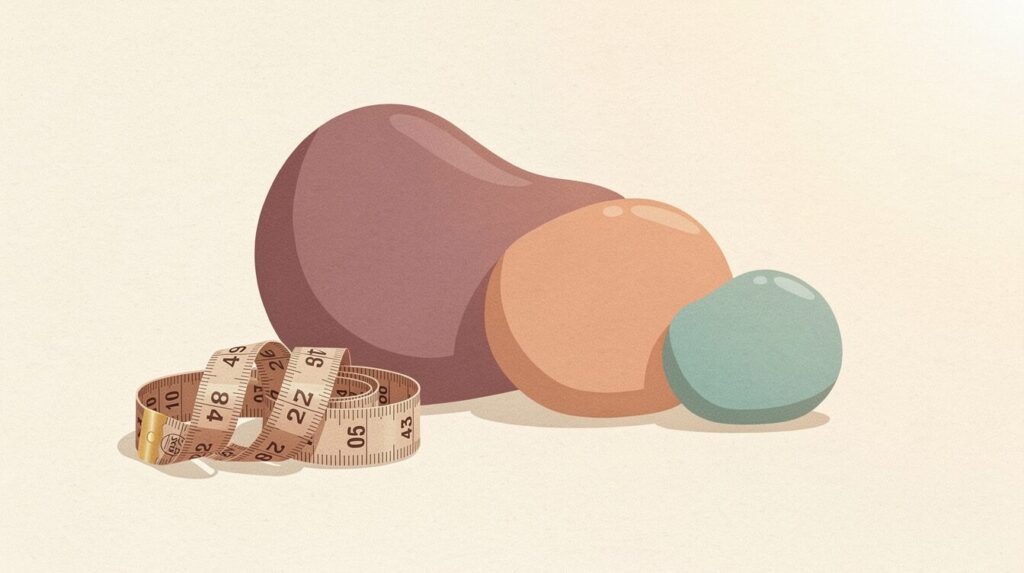
Diameter is the width straight across; girth or circumference is the distance around. Some listings quote one, some the other, and mixing them up is how beginners accidentally order something enormous. The conversion is simple: circumference ÷ 3.14 = diameter. So a listing that says “11 cm girth” means a diameter of about 3.5 cm — the very top of the beginner range, not a slim toy. If you ever need to check a toy at home, wrap a soft measuring tape (or a strip of paper you then measure against a ruler) around the widest point and divide by 3.14.
One practical calibration trick: two fingers held together are roughly 3 cm across for most adults. That’s a real-world reference point you already understand — no catalogue photo can distort it.
What Does a Realistic Dildo Size Chart Look Like?
Here’s the full range in one table, in both cm and inches, with an honest note on who each band actually suits. Bookmark this — it applies to any brand, on any platform.
| Size band | Insertable length | Diameter | Circumference | Best for |
|---|---|---|---|---|
| Petite / slim | 8–11 cm (3–4.3 in) | 2–2.5 cm (0.8–1 in) | 6.3–7.9 cm | First-timers who want the gentlest start; anal beginners |
| Beginner | 10–13 cm (4–5 in) | 2.5–3.5 cm (1–1.4 in) | 7.9–11 cm | Most first buyers — the recommended starting range |
| Average | 13–16 cm (5–6.3 in) | 3.5–4 cm (1.4–1.6 in) | 11–12.6 cm | A comfortable upgrade once the beginner range feels easy |
| Full | 16–20 cm (6.3–7.9 in) | 4–4.5 cm (1.6–1.8 in) | 12.6–14.1 cm | Experienced users who know they enjoy fullness |
| Advanced / XL | 20+ cm (7.9+ in) | 4.5+ cm (1.8+ in) | 14.1+ cm | Advanced only, sized up to gradually over time |
A pattern that shows up across published reviews: the size band people keep using long-term is overwhelmingly “beginner” to “average.” The bigger bands get bought on ambition and reviewed once. Buy for the body you have today, not the fantasy version of it.
Maison Velvetia size guide
Dildo Size Calculator
Enter girth to convert it into diameter, then match it to the same size bands used in our beginner guide.
Measure around the widest point. Valid range: 3–25 cm (1.2–9.8 in).
If a listing only gives total length, subtract about 2–5 cm for the base.
Diameter is calculated as circumference ÷ 3.1416 and rounded to 1 decimal place.
Privacy: this calculator runs only in your browser. Nothing is uploaded.
Does Size Work Differently for Vaginal vs Anal Use?
Yes — and this is the one section where sizing is a safety topic, not just a comfort one.
For vaginal use, the beginner chart above applies as written. The vaginal canal is elastic and self-lubricating, so a slightly ambitious pick is usually just uncomfortable rather than risky.
For anal use, three rules are non-negotiable. First, start smaller than you think — a diameter of 2–3 cm is plenty for a first attempt, because the anal sphincter doesn't stretch on demand the way people assume. Second, the toy must have a flared base wider than the shaft; the muscles there can genuinely draw a toy inward, and a flared base is the only thing that keeps it retrievable. Third, use far more lubricant than seems reasonable, because the area produces none of its own — Healthline's anal safety guidance covers the medical reasoning in plain language. If prostate play is what brought you here, our guide to the best prostate massagers in Malaysia goes deeper on anatomy and pacing, and our lubricant guide for Malaysia explains why water-based is the default choice.
One more note for couples exploring together: if the plan involves a harness, the flared base is also what locks the dildo into the O-ring — so size and base shape decide harness compatibility, not just comfort. Our couples' guide covers that conversation in more detail.
How Do You Read Size Information on Malaysian Listings?
Shopping on Shopee MY or Lazada MY adds a local layer of confusion, so here's what to watch for — learned the hard way so you don't have to.
Assume the headline number is total length. A "7 inch / 18 cm" listing very often means 14–15 cm insertable once you subtract the base. If the listing doesn't split the two numbers, message the seller and ask for insertable length and diameter — a seller who knows their product answers in minutes, and a seller who dodges the question just answered a different question.
Watch for inches quietly becoming centimetres. Malaysian listings switch units mid-description surprisingly often. A "5.5" in the title might be inches (14 cm — reasonable) or a mistyped 5.5 cm diameter (enormous). If a number seems odd, convert it before you trust it: 1 inch = 2.54 cm.
Price bands hint at honesty. As we covered in our full guide on how to choose a body-safe dildo in Malaysia, RM 80–180 is the realistic band for a genuine entry-level 100% silicone piece. A "medical silicone, 20 cm" listing at RM 25 is telling you two lies at once. Material honesty and size honesty tend to travel together — and delivery-wise, reputable sellers ship discreetly via J&T or Pos Laju in 2–5 working days with nothing identifying on the parcel, whether you're in a KL condo or a small-town address.
Reviews reveal true size better than photos. Product photos use forced perspective; reviewers don't. Skim reviews for the words "smaller than expected" or "bigger than expected" — Malaysian buyers are refreshingly blunt about this.

How Do You Size Up Safely Over Time?
Once the beginner range feels genuinely easy — not tolerable, easy — you can explore upward. Move one band at a time, which in practice means adding no more than about 0.5 cm of diameter per step. Jumping two bands is how people convert curiosity into a bad evening.
A few habits make sizing up smooth. Warm up with what you already own before trying the new size. Use more lubricant than you did with the smaller toy, since a larger surface needs it. Give each new size several sessions before judging it — first impressions of any size skew negative because your body is busy processing novelty. And keep whatever you bought first: smaller toys stay useful for warm-up, travel, and days when your body wants gentle rather than ambitious.
Also worth saying plainly: sizing up is optional. There's no progression ladder you're obliged to climb. Plenty of people find their size on the first purchase and happily never change it — that's not a lack of adventure, that's a successful search that ended early. If you're still choosing your very first product overall, our first toy guide and our intimate wellness beginner's guide for Malaysia zoom out to the full decision, not just size.
Whatever size you land on, remember that fit is only half the story — the material touching your body matters just as much. Our deep-dive on body-safe materials explains why 100% silicone, borosilicate glass, and stainless steel are the only three worth buying, and our guide on cleaning intimate products properly keeps whatever you choose hygienic for years — especially important in Malaysia's humidity.
Which Shape Features Change How a Size Feels?
Two toys with identical measurements can feel like completely different sizes once shape enters the picture. Before you commit to a number from the chart, run your pick past these four features — they're the fine print of how to choose dildo size well.
Tapered tips make any diameter friendlier
A toy that starts slim at the tip and widens gradually toward its full diameter lets your body adjust progressively instead of all at once. For beginners this is the single most forgiving shape feature — a tapered 3.5 cm toy often feels easier than a blunt 3 cm one. If you're nervous about a size, a taper buys you comfort without giving up the measurement you wanted.
Curves target, straight shafts forgive
A gentle upward curve directs pressure toward the G-spot or prostate, which is why so many well-designed toys have one. The trade-off: a curved toy is more opinionated about angle, so it can feel larger when the angle is wrong. Straight designs are less intense but far more forgiving while you're still learning what angles your body prefers. There's no wrong answer — just know that curve adds perceived intensity to the same diameter.
Texture adds perceived girth
Ridges, ripples, and pronounced veining all increase how thick a toy feels in use, typically by the equivalent of a few millimetres of diameter. If a listing shows heavy texture and you're between sizes, choose the smaller one. Smooth or lightly contoured surfaces are the safer beginner call — you can always add texture on a second purchase once your baseline size is settled.
Bases decide what a toy can do
A flared base is the safety requirement for any anal use, but it also determines whether a toy works hands-free against a shower wall (suction cup) or locks into a harness for partner play (wide flange). Bases add to total length but not insertable length — one more reason the two numbers on a listing differ. If there's any chance you'll want versatility later, a flared base costs nothing today and keeps every option open.
Put together: the beginner-friendly build is a smooth or lightly contoured shaft, a gentle taper, an optional mild curve, and a flared base, in 100% platinum-cured silicone. That combination makes every measurement on the chart feel like its friendliest version of itself.
Frequently Asked Questions
What size dildo should a beginner start with?
A beginner should start with an insertable length of 10–13 cm (4–5 inches) and a diameter of 2.5–3.5 cm (1–1.4 inches). This dildo size guide range is manageable for nearly everyone, and it's easier to size up later than to recover from starting too big. Prioritise diameter over length when choosing between two options.
Is a 12 cm (5 inch) dildo too small?
No — 12 cm insertable is right in the most-used range. Peer-reviewed research on 15,521 men found the average erect length is 13.12 cm, so a 12 cm toy is essentially average-sized. "Small" in marketing photos and small in real use are very different things; the sizes people keep reaching for long-term cluster around this exact band.
Should I choose a dildo that matches my partner's size?
Only if that's what you enjoy — there's no rule that a toy should replicate a partner. Many people deliberately choose a different size or firmness so the toy offers a different experience rather than a copy. If you do want to match, measure insertable length and circumference honestly, then convert circumference to diameter by dividing by 3.14.
What size dildo is safe for anal beginners?
For first anal use, choose a diameter of 2–3 cm with an insertable length of 8–12 cm, and only use toys with a flared base wider than the shaft. The flared base is a genuine safety requirement, not a preference — anal muscles can draw a toy fully inward without one. Pair it with plenty of water-based lubricant and unhurried pacing.
How do I convert girth or circumference to diameter?
Divide the circumference by 3.14 (pi). A toy listed with an 11 cm girth has a diameter of about 3.5 cm; an 8 cm girth is roughly 2.5 cm across. This conversion matters because Malaysian listings mix the two measurements freely, and a girth number mistaken for a diameter leads to ordering something dramatically larger than intended.
Do Shopee and Lazada Malaysia listings show insertable or total length?
Usually total length, because the bigger number photographs and sells better. Subtract 2–5 cm for the base or handle to estimate insertable length, and message the seller to confirm if the listing doesn't split the two. Sellers who know their products answer quickly with both numbers plus the diameter.
What if the dildo I bought feels too big?
Don't force it — discomfort is information, not a challenge. Slow down, add significantly more water-based lubricant, spend longer on warm-up, and try again on a different day when you're relaxed. If it still feels like too much after several patient attempts, set it aside and get a smaller size; many people later return to the bigger one once experience builds.
Does the material change how a size feels?
Yes, noticeably. Borosilicate glass and stainless steel have zero give, so the same diameter feels roughly half a size larger than it would in silicone. Soft dual-density silicone feels gentler than its measurements suggest. If you're choosing a firm material for your first toy, size down by about 0.5 cm in diameter to compensate.
The Bottom Line on Beginner Sizing
A good dildo size guide for beginners comes down to three habits: start at 10–13 cm insertable and 2.5–3.5 cm diameter, judge every product by its diameter before its length, and never trust a single unlabelled number on a Malaysian marketplace listing. Get those right and the intimidating part of the purchase disappears — what's left is just choosing a colour. Size is personal, bodies change, and the only measurement that ultimately matters is the one that makes you want to come back. Start modest, stay curious, and let your own comfort — not a catalogue — set the pace.
Ready to choose your first piece?
Grab our free Size-Selection Cheat Sheet using the signup form in this article — insertable length vs girth, beginner ranges and a 5-point pick, on one page to shop with. And when you're ready to buy, our affiliated retailer Secret After Dark lists pieces by stated material and says it delivers discreetly across Malaysia — check the stated material and size on each product page against the checklist.
Affiliated retailer
Ready to shop?
We don’t sell products here — when you’re ready, you can browse Secret After Dark, our affiliated retailer in Malaysia, which says it ships in plain packaging.
Browse Secret After Dark →🎁 Join our Telegram channel for a channel-only 10% code at Secret After Dark →
Enjoyed this guide?
Get our best evidence-based intimate wellness guides in your inbox — Malaysia-specific, zero judgment, no spam. Subscribe free →
Start here · The path
Not sure what to read next? New here? Follow this 4-step path for a solid foundation 👇
Keep reading